Showing posts with label Bombay Slum. Show all posts

Wednesday, 4 December 2013

Water - The Most Basic Human Need

The other morning, I got talking to our home-help Reetha about her daily routine.  As part of that conversation, I asked her about drinking water and water for washing.  Mop in hand, she told me that she was lucky because she didn't have to take a water jar and collect water anymore.  Because now she has piped water in her slum, with a faucet just outside her door. For two hours every morning, water passes through the pipes, allowing Reetha to collect enough water for washing and drinking.  However, she tells me that the first 30 minutes are a waste of time as she has to wait for the water to wash through the system - as it is black and vile and only after half an hour, does it start to become clear.

Washing in an Indian slum involves a bucket and a cloth.  No fancy chrome shower fittings!
Because the water only comes early in the morning during that two hour slot, Reetha only has a limited time in which to wash herself, her family, her clothes and her home before she even starts her day's work - cleaning the apartments of four expat clients. Reetha sets off for work at 7.30 am from her home in Andheri, taking the bus to Bandra.  Between 9 am and 4 pm she will have cleaned three homes in Bandra before travelling to her last job of the day in Powai. This can be a two hour journey or worse in bad traffic. She doesn't take a rickshaw because it is too expensive. And she doesn't get home until 10pm when hopefully her son or daughter will have cooked the family a meal in their 12ft x 12ft chawl. If not - she does it herself because her alcoholic husband is too useless to help.

Slum dwellers waiting for the water truck.  (Photocredit)
Our driver Peter lives in a similar situation (although it's just him and his father whom he cares for, with no women-folk to help).  In fact Peter does not own an alarm clock - he is awoken every morning by a neighbour who passes by on his way to collect his daily allowance of water.  Although some are 'lucky' with their piped facilities, others have to carry water pots to the nearest outlet and then carry all they can manage on their heads back to their dwelling. It's worse than medieval England. 

Whilst I sit here in my apartment with its three bathrooms and kitchen, I can't help feeling extremely guilty. (I feel guilty about many things!) Except for those rare cases when there is a Mumbai-wide water shortage (say, if the monsoon has been poor), our water is on tap 24-7. And although you wouldn't want to drink the water unless it has been filtered, it is at least clean and constant.  This basic human need - which is abundantly used to clean our floors, bathrooms and kitchen (never mind cooking) - really is an absolute luxury for the majority of Mumbaikars (after all, approximately 85% of Mumbai's 20m population live in slums, chawls or on pavements). I always ask Reetha to drink our bottled water when she is here and encourage her to fill up her flask before leaving. Even 13 Rs for a litre of Bisleri will be a chunk out of her daily budget.

Huge pipes carrying water down to the city's apartment dwellers from Powai Lake - as seen from Bandra Skywalk
I have no idea whether Reetha and Peter live in slums that are recognised by the government (these are called 'notified' slums, e.g. Dharavi). If they are 'notified', then they will have access to clean municipal water supplies.  If not - their water will be provided by 'informal means' - perhaps community run or privately supplied by standpipe or water truck. Us apartment dwellers will have seen the water trucks that traverse Mumbai - ironically with precious water pouring out of a broken tap at the rear - and perhaps you have seen the crowds of people patiently waiting to fill up their water bottles. Not only will this type of water supply be charged out at hugely inflated prices, but is also more likely to be contaminated with E.Coli bacteria. 

Typical Mumbai water trucks. Photocredit: Kuni Takahashi
I know through working for an NGO, that unclean water is a huge problem for the children of Mumbai. Bacteria in the stomach quickly leads to diarrhoea and vomiting, exacerbating the conditions leading to malnutrition. If children can't retain food and water, they become nutrient deficient and dehydrated, leading to even worse health issues....and sometimes death.  During the monsoon season, the problem becomes even more serious - a recent study found that 50% of point-of-source water samples were contaminated during the rains. And that is before it even reaches 'point-of-use' in the household itself. Stagnating water around the home can further attract mosquitos - leading to a high risk of malaria infection. 

So whilst we sit in our ivory towers, spare a little thought for the daily struggle of Mumbai's majority - I naively hope that one day, free and clean municipal supplies of water will be made available to the masses...this is a city that claims to be very much in the 21st century after all!

(The fact that there is one toilet per 1,500 persons in Dharavi - is subject matter for another post)


Stagnant water sits in between huge pipes...children will often play, pee in and drink from pond and river water.
Can you imagine???? 


Wednesday, 20 November 2013

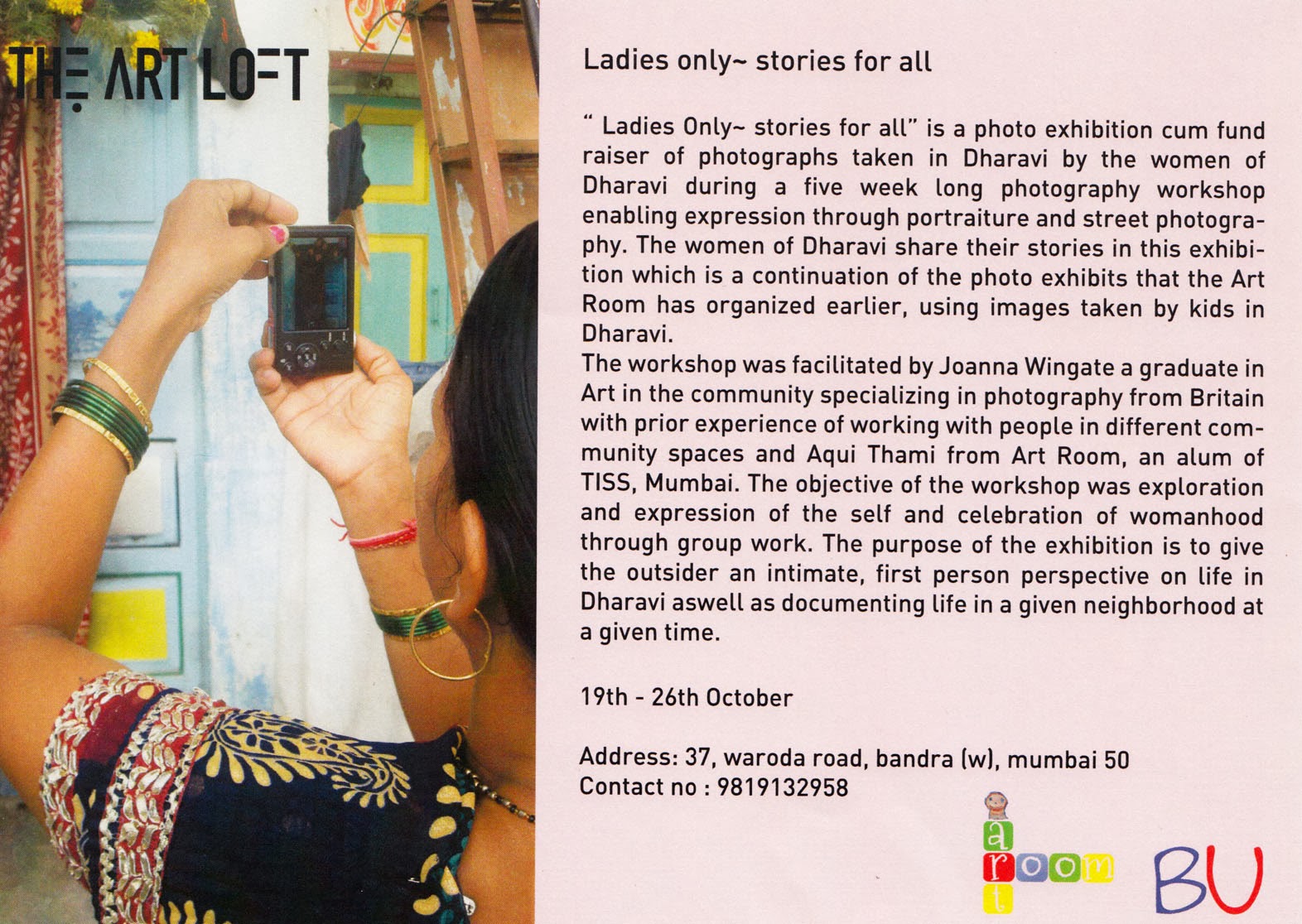
The Dharavi Cameras - Follow-up News

I received an email today that made me so happy.  It concerned the cameras that were donated by followers of the blog to a Reality Gives project - please read this post and this post.  To cut a long story short - I went to an exhibition of photographs taken by the kids of Dharavi ('Asia's largest slum') and I was so blown away by what they had achieved that I asked readers to donate cameras to the project - so that more children could benefit from photography classes initiated by the NGOs Reality Gives and Bombay Underground. We received nine cameras (successfully brought back in a suitcase from the UK by Mr Jules despite heavy questioning by Indian customs at the airport!) and I took them down to Dharavi last June.

I had been meaning to follow up on what had happened with the cameras - and as it transpires, they have been put to fantastic use.  Because it has not just been the children of Dharavi who have been able to make use of the equipment.  Through this latest project (described below), a select group of women were taught to be self-confident and self-aware through the medium of photography.


Here is a report from Joanna who kindly emailed me this morning with the news and photographs from the programme:

"The project ‘ladies only – stories for all’ was a collaborative venture between myself, Joanna Wingate, and Aqui Thami, from the Art Room. The workshop ran for 10 sessions, 2 hours a session in Dharavi, Mumbai.
The workshop focused on using photography, story telling and interviews, as a way of expressing how to be ‘free’ in a safe environment. The aims were to create positive awareness and raise self-confidence, and to build new relationships between the 5 participants.
We believe we achieved this as far as possible in the short time available. It was the first photography workshop for women in Dharavi. I taught them new skills, using basic camera techniques including: angles, composition, different props such as the use of tripod, and reflector. We followed various themes, such as ‘faceless portraits’, ‘abstracts’, ‘a day in a life’, and environment and street photography. I am certain, that most of the participants, loved ‘portraits’, which was their favourite. They imagined being somebody else - such as a Bollywood star for one session. At the end of the project, we went on a trip to Colaba, looking at different galleries, focusing on ‘Photography’ and ‘Women in Indian Photography’.
I conducted the sessions in English and Aqui, translated the workshop into Hindi for the group. This was the first such experience for me. Our group was a multi language group! English, Hindi, Marathi and Telegu.
One participant told us that she felt ‘young, free, and not having to worry about marriage, life, and children during the session’. For me, that was a positive step, to help the participants to be themselves and relax in a safe environment. Another participant said that she likes to dress up and feel good about herself in the sessions. I was so encouraged that they really enjoyed spending time together. Even though they had much work at home, they still made an effort to come each time, and did not drop out during the 10 sessions, as they created something new.

I hope the audience will enjoy the participants’ images - Amirita, Anuradha, Kaveri, Nirmala and Shobha. You can see them at the exhibition and in our photo book"

The work culminated in an exhibition at the Art Loft in October which I unfortunately missed due to travelling. So I would like to say 'well done' to Joanna and her team for doing such a fantastic job with these women. And it's so inspiring when you hear of other expat women using their skills and doing something so worthwhile with their time. 


The five participants, Joanna and Aqui
Time for laughter and forgetting the stresses of their daily lives


Thank you Joanna and Aqui, you've made a real difference to these women!

Thursday, 31 January 2013

How to Spend 48 Hours in Mumbai

Mumbai is not really what I would describe as a ‘holiday’ destination where people stick around for very long.  48 hours is usually just enough time to get a taste of the city before moving on to the tourist trail of the Golden Triangle, ‘God’s Own Country’ Kerala, beachy Goa or the crisp, fresh air of the Himalayas.  If you are stopping off in Mumbai before a 'grand tour', or if indeed you live here as I do and are entertaining guests in the city for a couple of days, the following is a compact guide on what to do and where to go.
 
I will show you how to see the beautiful and not so beautiful sights of the city, where to go for an introduction to Indian street food and where to go shopping for good souvenirs. My guide assumes that you have access to a car and driver.  If you don't have your own driver, it is possible to hire one quite cheaply and will mean you can pack an awful lot more in than if you got the train or bus.  (I am also not ‘at one’ with the Mumbai public transport system!) It also assumes that you will do a bit of pre-planning with a street map.
 
(This is all tried and tested by BombayJules by the way!)
 
Day 1
 
I will usually try and make an early start before commuter traffic peaks at 10am, aiming to get to Banganga Tank at the bottom of Malabar Hill by 9am.  Banganga tank is the oldest and most sacred Hindu site in the city where Lord Rama is said to have brought forth water from the Ganges by firing an arrow into the ground.  It is a place of rare serenity and there are usually photogenic pilgrims and worshippers to be seen ‘purifying’ themselves in the waters.   You might even see some of the many ducks that reside there floating around.  Surrounding the tank are a few Hindu and Jain temples – take your pick at which one to look at, remembering to take off you shoes before you go in.  Hop back in the car and take the five minute drive to The Hanging Gardens of Malabar Hill from which you can get your friends to line up at the in front of the wonderful view of Marine Drive.  Passing back via the giant boot (if you’ve got kids, let them go up to the top) and crossing the road, you will enter Kamala Nehru Park with its perfectly manicured hedges and topiary animals, green benches and colourful flowerbeds.  This is a rare haven in Mumbai – verdant, well kempt and rubbish free.
 
By now you are probably feeling a little peckish - so get back in your car and drive past the almost completely hidden Towers of Silence - you can just get a glimpse through the trees on your left.  The Towers of Silence are where the Parsis (Zoroastrians) place their dead. I suggest you look up the reason for this on Wikipedia so you can amaze yourself/your friends with the information! Keep going straight until you are back on Babhulnath Marg.  If you want to, hop out here and take a look at Babhulnath Temple (another one of the city’s holiest Hindu sites) – the steps leading up to it are lined with traditional Gujarati houses for temple workers.  Having done that, get your driver to park up whilst you cross back over the main road for a nice, reasonably priced lunch at Soam.  Soam is my favourite place in Mumbai to experience street food in a safe, clean and quality environment.  If you’re new to Bombay street food yourself, get the friendly restaurant owner to show you and your guests how to eat Pani Puri. You should also try to sample the amazing masala dosas, sev puri, and farsans.  Yum.
 
After lunch, you are now ready for a quick/optional diversion to nearby Anokhi off Hughes Road – especially if there are women in the group, (well women like me that can’t resist a quick shop!)  At Anokhi, you will find irresistible hand block printed items from Jaipur, all at very agreeable prices.  Cotton tops, long skirts, fabulous table cloths and printed notebooks. 
 
Now, get your driver to drop you at the start of Marine Drive so that you can take a 20 minute stroll along Girgaum Chowpatty.  Chowpatty means ‘beach’ in Marathi.  If you go right down to the sea, you will unfortunately witness the rubbish that is so prevalent in and around Mumbai.  But don’t worry, you'll soon get used to it!  Oh, and I don’t need to tell you not to go anywhere near the water. 
 
Next, pick up your car again and come away from the beach by heading east - asking your driver to go towards Crawford Market.  Get out here and go through the front entrance where you will be immediately greeted by the hustle, bustle, sights, sounds and smells of Mumbai’s most famous shopping bazaar.  Try not to veer into the caged animal section where birds, cats and dogs are for sale, Kept in small cages without visible evidence of water, it can be very upsetting to see.  After mooching around for a bit in the market you will find that it’s almost time for a cup of tea.    Get back in the car and head down DN Road so that Victoria Terminus (Chhatrapati Shivaji Terminus in new money) is on your left hand side.  No need to get out of the car, just enjoy the ‘Victorian Italianate Gothic Revival’ architecture of Mumbai’s main transport hub, built in 1808.  There is plenty of similar Raj-era architecture to admire in the vicinity, such as the Bombay High Court and the University of Mumbai and The Prince of Wales Museum.  Carry on going straight towards the sea, getting off at the next stop – The Gateway of India. 
 
Get out here and proceed through the (defunct) security gate. Take a few photos with your clan in front of the Gate, have a look out to sea, do your best to avoid the photo-touts and giant balloon sellers (I still haven’t fathomed why on earth one would need a balloon the size of a small car) then turn around, go back and cross the road.  You will now be right in front of the Taj Mahal Palace Hotel on Apollo Bunder.   Admire the grandeur of the building, pass through the lobby and go up to the SeaLounge on the first floor.  Here you must sample a very expensive cup of the divine Silver Grove White Tips Darjeeling tea whilst looking out to sea - as smooth as a silk sari.  Whilst chatting, you can think about the 2008 Terrorist Attack centred around the hotel where 200 hostages were rescued but 31 guests were unfortunately killed.
 
Get collected again and go around the back left hand corner of the Taj Palace Hotel and find the small Good Earth Shop on BEST Marg.  Delight in the Indian themed cushion covers and crockery etc...but beware of the western prices. 
 
After the thrill of Good Earth, you’ll need to come back down with a cocktail.  Drive back to Marine Drive and find the Intercontinental Hotel about a third of the way up on the right hand side.  Clear security and take the lift up to the magnificent (and trendy) DomeBar on the top floor.  I actually like to ask for a white wine spritzer (you have to explain to the waiter - white wine with soda with ice) which is a perfectly refreshing accompaniment to what I consider to be one of the best views in Mumbai.  You can while away a few hours watching the stunning sunset and chatting before going to a restaurant of your choice to sample some more Indian food – or perhaps just stay at the in-house restaurant Kebab Corner where you’ll find some of the tenderest Chicken Malai to be had in the city.
So that’s the end of Day 1.
Day 2
 
And now for something a bit different.  Do you think I am going to show you the street markets of Mumbai (Colaba, Fashion Street, Linking Road etc) or an art gallery or museum? Wrong!  Day 2 of my itinerary is an optional alternative to the usual tourist trail.
 
Today starts in the “Queen of Suburbs” - Bandra - at 10am.  If you are coming from South Mumbai, come via the Sealink – the city’s best and most scenic feat of engineering.  Find your way to Carter Road (starting at Otter’s Club), hop out of the car and walk along the sea promenade. Get some of that sea air into your lungs!  After 20 minutes or so, drive back towards Pali Market, going up and down some of the streets in order to admire the Art Deco bungalows of a bygone era. Some are decrepit, but some have been restored to stunning effect.
 
Heading back in the direction of Carter Road along Hill Road, find Ben Hur Chemist opposite pretty St Andrew’s Church.  Get out of the car here and walk down Waroda Road which is off at an angle just before the chemist’s.  Waroda Road and its offshoot Chapel Road, are part of Ranwar Village - a charming bohemian enclave, with colonial bungalows, narrow streets and artistically graffitied walls.  Ranwar (now favoured by French hipsters) is one of the original 24 pakhadis (hamlets) that made up Bandra since the earliest documented history in early 1700s, and has managed to retain its village character even as present-day development has hemmed it in on all sides.  The street art is fun to look at – some of it is slightly naïve, some of it highly artistic. 
 
Get your driver to pick you all up again from Hill Road and then drive 30 minutes (max) to Matunga, south of Mahim (and not via the Sealink). You will probably go past Dadar Flower Market on the way.  Matunga is famous for its South Indian restaurants, very much favoured by the local vegetarian Gujurati community.  Head for the most famous of these restaurants - Café Madras (Bhaudaji Road, Kings Circle) for brunch.  At weekends it can get very busy and you may have to queue.  Café Madras is an excellent place to sample a traditional Indian breakfast – food items such as idlis, dosas, wadas and rassam.  Perhaps stay away from the coconut chutney accompaniments in case of fragile stomachs!  But it should all be perfectly safe.
 
After your brunch/lunch, you can browse some of the pavement bookstalls or take a look around the local vegetable market to give your guests a true flavour of local life. If you want, take a peek at the King’s Circle nearby, another rare area of greenery.
 
You then need to get yourselves to Mahim station by 2.30pm where you will meet one of the tour guides of Reality Gives Tours & Travel (www.realitytoursandtravel.com).  You are going on a tour of Dharavi which you have prearranged. It is hard to ignore the shanty towns of Mumbai so why not educate yourself and your companions about the amazing enterprise that goes on in Asia’s biggest and most profitable slum?  It’s not half as scary as you might think and the tour seeks to break down negative or misinformed attitudes towards less developed communities. You will be led around a pre-organised route where you are encouraged not to gawp and you will come out with a completely different view of the ‘Heart of Mumbai’.  No photos are allowed and you will have to try and be subtle about unfavourable smells.  I have taken several people on this tour and they have all appreciated the experience and been enlightened by it. The cost is only 600 Rs per person or 3,000 Rs for a private tour for up to five persons. 80% of profits made by Reality Gives are ploughed back into the community.
 
Two and half hours later, the Reality Tours tour guide will speak to your driver and tell him to collect you from their office on the other side of Dharavi - where you can also by some mementos of the tour.  Now you can relax!  Gather yourselves up, get in the car and drive to Phoenix Mills shopping mall in Lower Parel (around 30 minutes depending on traffic).  This is partly to show the immediate contrasts between rich and poor and partly for them to pick up some more souvenirs.  Plus it’s nice and cool in there.
 
Admire the Gucci, Burberry and Jimmy Choo outlets in Palladium and then go down to the ubiquitous FabIndia and Bombay Stores where you can pick up some more quality souvenirs.  For dinner, there is a multitude of safe bets here – I would particularly recommend Rajdhani for an excellent and never-ending Gujurati thali experience (if you are sticking with Indian food) or Serafina, the Italian Pizzeria if you want a change of scenery.

Your BombayJules tour is now finished!
 
 
Left to right, top to bottom
1. Banganga tank 2. Topiary of Kamala Nehru Park 3. Anokhi prints 4. Pani Puri at Soam 5. Bustling Crawford Market 6. Gateway of India 7. Dome Bar 8. Colonial bungalow of Bandra 9. Graffiti of Waroda Road 10. Matunga Vegetable Market 11. Dharavi 12. Phoenix Mills Mall.

Thursday, 23 August 2012

Another day in the life of a volunteer

Today was an exciting day for the Foundation as we opened another site from which to do more great work. (New readers: I volunteer for a charity that will remain nameless for now but educates and treats women and children suffering from malnutrition, read more here... http://bombayjules.blogspot.in/2012/07/if-food-be-music-of-lifeeat-on.html). This new 'clinic' is close to the two existing clinics, in the drying area ("Sukhawni") of Dhobi Ghat - the largest outdoor laundry in the world.

Dhobi Ghat drying area - "Sukhawni"

So this morning, I traipsed with my colleagues through muddy groundwater and down a few alleyways to get where we were going (note to self, buy some plastic shoes, do not wear your shiny silver ballet pumps when you visit sites).  When we got there, there were already loads of staff, volunteers, friends and members of the community awaiting the grand opening.  Everybody was cramped into a small area with local people trying to go about their daily business, squeezing past us the whole time with bundles of laundry.  I am sure most of those around us must have wondered what on earth was going on, especially as half the crew had 'white' faces and were carrying huge cameras.


Some of us may have had designer handbags, but someone living here has a designer dog!

The new "site" - where people from the community will be able to visit the Foundation's doctors, nurses, nutritionists and social workers - is actually just one room that is about 12 square feet.  So therefore probably about a third of the size of your sitting room (for most of you back home reading this).  In fact they were lucky to get this room at all - in a city where space is at a premium and people are living on the pavements with no cover over their heads, this 12 ft square box could be a home for a family of eight.  But instead the community has turned it over to the Foundation (for a small rent) because they have heard of the work it does in improving the lives of so many and helping children to reach their full potential.  Seriously...lives will be vastly improved, if not saved, from this box. 

After managing to cram the whole crew into the alleyway, the ribbon across the door was snipped, the coconut was smashed and everybody attempted to get into the tiny room, leaving their shoes at the doorway (20 Indians, 2 Brits, 1 Canadian and 2 Americans). Mithai (sweets) were handed around and there was a lot of a laughter. (There always is in India, no matter what).  A great day for the Foundation.

I ended up taking so many photos of the amazing kids that came to see what was going on, so there are loads of pictures here.  Thanks for looking.


Waiting for the main event - this little girl has got her Sunday best on


I just thought this girl was so beautiful!  probably 14 or 15, sitting on the floor sorting out laundry


Everything has a use - this old rice sack used as a roof covering

The scissors that would be later used for cutting the ribbon for the opening ceremony.  Beautiful "Mehendi" hands

There's that beautiful girl again.  So photogenic...

A very grumpy looking community activist.  She's the one responsible for helping to get the third site open.


The cocunut that would later be smashed at the opening ceremony

Two proud schoolgirls enlisted to hold the ribbon for the opening ceremony

Love this cheeky looking fella!

The crowd trying to squeeze into the alley outside the new site just before the cutting of the ribbon

The ribbon cut! (didn't manage to get a good photo of that).  Everyone is smiling.

So funny - this little girl wearing shades - she looks like a Bollywood star being papped!

Everyone inside, everyone's shoes outside


How many people can you squeeze into a 12 sq ft room?  Oh, about 25!


One smashed coconut

Handing out of mithai (sweets) to celebrate (where's the champagne darling?)


These are the people living above the room.

A view of the street on the walk back - see all the ladders leading to the homes above homes (also note the satellite dishes!)

They wanted me to take their photo...little rascals!

Saturday, 23 June 2012

See : Today I Slummed It

I did it.  I did a tour of the biggest slum in Asia, Dharavi.

Mahim station in the heart of Mumbai is where I met the rest of the tour group and the tour guide from marvellous Reality Tours & Travel. Prior to my arrival I made sure I was well prepared for a very long walk (being the start of the monsoon season), with covered waterproof shoes - (I knew I would freak out if I got 'ick' on my feet), a long anorak and a big bottle of water. It was going to be a long one.

Reality Tours and Travel, provides educational and fun tours in and around Mumbai and 80% of the profits after taxes from these tours go towards funding the work of Reality Gives(sister NGO).  You may think that it is voyeuristic to do a tour of a slum but by doing it this way, you get to see what really goes on in an organised and safe way whilst financially contributing to the community.  We were not allowed to take pictures once inside the slum in order to preserve the dignity of the inhabitants but I did take the two below just before we went in.  The first is of Ganesh, our enthusiastic and interesting guide and the second is a view of the entrance to the slum from the footbridge just down from Mahim station.


Ganesh, our Guide from Reality Tours & Travel


View of one of the entrances into Dharavi.
Dharavi of course was made famous by the film Slumdog Millionaire but what a lot of people do not know is that it generates $665 million turnover every year, mostly created by huge recycling activities, leather making and food production.  Over a million people are packed into 1.75 square kilometers of land and many of its inhabitants are educated enough to work for multi-nationals companies.  In fact I was surprised to learn that many of the original slum-dwellers actually rent out rooms in the slums once they are able to get out!! In a city where rent is sky high, some of the dwellings can achieve 1,500-2,000 rupees a month (£20-30).

The main emphasis of the tour was to show us how self supporting the slum is and that everybody is working hard to better their lives and the lives of their children.

We wound through tiny alleyways, up ladders and through rubbish dumps to see daily life.  From a roof top we could see the amount of recycling materials that are brought from all over Mumbai, as well as other parts of the world such as the USA and China.  Items such as fridge interiors, plugs & sockets, old phone handsets, plastic toys, paint tins and oil cans wind up here. The plastic items are all processed in machinery mostly made in the slum itself and comes out as tiny pellets that can be later melted and moulded into any plastic object you want.  We saw a massive warehouse full of huge vegetable oil tins that would be cleaned in boiling vats of water for reuse later and aluminium items that are re-processed in large grossly hot furnaces with deadly aluminium dust flying around and no type of breathing protection for the men tending them. The health and safety aspect of this tour will leave you speechless when you see what kind of conditions these people have to work in when it is already so hot and humid outside to begin with.  There are no gloves, no eye protection, no overalls, no NOTHING!

We also saw ladies making poppadoms (papads). Ganesh explained to us that someone came up with this idea to empower women in the community and give them a way of generating income for themselves.  They are given large bags of special dough and they spend the day rolling it out into thin discs and them drying them on huge upturned baskets in the baking sun.  These are then collected up by the 'poppadom dealer' who in turn sells them to large national and international companies.  Next time you eat a poppadom, perhaps you can think of where it may have come from!!  No comment on Food Hygiene either....

Nearly the most exciting moment of the tour came for me when we arrived at the leather processing area where I was told they made leather handbags....not just any old handbags but handbags for Gucci and Dior and a host of other designers.  I was nearly apoplectic with excitement with visions of being able to buy heavily discounted leather items and that my money would go to directly help this poor community!!!  Alas, we were not shown any 'samples' or anything remotely like a designer handbag. I am sure if it is true that such luxury goods are made in a vicinity that the 'Designer Police' would want to keep it well under wraps. Sigh...

Wondering through the residential areas, we got to see the tiny cubes that families of up to nine or ten sleep in.  They contain a small tub in one corner for the ladies to wash themselves (the men and children have to clean themselves outside in the alley) and nothing else.  There are no cupboards or anything that could take unnecessary space and everyone sleeps on the floor.  Most have electricity and access to water but most people have to use the government supplied latrines to go to the toilet. In India it is a well known fact that only about 30% of people have access to a toilet but yet most people (at least 60%!) have a mobile phone. It amazed me to see so many people in the slum, sitting around chatting on their cellphones, when they otherwise have next to nothing.    

Some of the units were fully equipped with televisions and satellite TV (a bit like your English Council house then) and refridgerators. The communities have access to schools, English lessons and womens' groups.  There is even a women's football team which is very popular with young students.

The children that we came across in the alleys, up ladders and in the rubbish dumps were extremely delightful. They all want to say hello and cling on to your hand.  I never once saw a child crying or without a smile on its face (except when I tried to play ball with a little toddler boy and ended up throwing it at his head by accident!).

Apart from being utterly exhausted by the Mumbai heat, I did come away from the tour with my preconceptions of what a slum should be blown out of the water (although we are told Dharavi is unique in maintaining its own economy). I would highly recommend that anyone visiting the city gives it a go. And I would also highly recommend that you use Reality Tours & Travels (Reality Gives) as the tour fees will be reinvested into the Dharavi community. 

See the link here: http://www.realitytoursandtravel.com/ 


Never missing an opportunity to buy a new bag.....

We paid 500 rupees for the 2.5 hour tour (about £6/$9.50) and there is also an opportunity to buy picture postcards, T-shirts and canvas bags at the Reality Tours office at the end of the gig. (I of course never miss an opportunity to buy a bag - which I did for 500 rupees).